Short answerFresh liver contains catalase, an enzyme that splits hydrogen peroxide into water and oxygen very fast. Boiling changes the shape of the enzyme for good: it is denatured, so it can no longer work, and the boiled liver gives almost no oxygen.
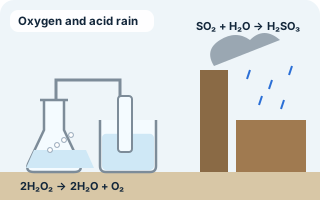
🧪 Try it in the free lab. In the free Oxygen, oxides and acid rain lab you make oxygen with fresh liver, boiled liver and MnO₂, plot the gas volumes, and then go on to oxides and acid rain.
Open the lab →The reaction
Hydrogen peroxide breaks down slowly on its own into water and oxygen:
2H₂O₂ → 2H₂O + O₂
A catalyst makes this happen much faster without being used up. Two catalysts are used in school: manganese(IV) oxide (MnO₂), a black powder, and catalase, an enzyme found in almost all living cells. Liver has a lot of it. Cells need catalase because hydrogen peroxide is made during metabolism and would damage them if it built up.
Why boiling stops the enzyme
An enzyme is a protein folded into an exact shape. Hydrogen peroxide molecules fit into one part of it, the active site. At high temperature the protein vibrates so much that the bonds holding its shape break. The active site changes shape and the substrate no longer fits. This is called denaturation, and it is permanent: cooling the boiled liver does not bring the enzyme back.
MnO₂ is not a protein, so heating it does not stop it working. That difference is the clue that liver contains a biological catalyst.
The method
- Put 10 cm³ of 3% hydrogen peroxide into a conical flask joined to a gas syringe, or to an upturned measuring cylinder of water.
- Add 2 g of fresh liver cut into small cubes, close the flask quickly and start the stopwatch.
- Record the volume of gas every 30 seconds for 2 minutes.
- Repeat with 2 g of liver that was boiled for 5 minutes and cooled, then with 0.5 g of MnO₂, then with no catalyst.
- Test the gas with a glowing splint: it relights in oxygen.
Safety: wear eye protection, as hydrogen peroxide irritates the eyes and skin. Wash your hands after touching raw liver, and do not eat anything from the lab.
Example readings
These are example readings of the kind you get in the lab; your own numbers will be a little different.
| Time (s) | Fresh liver (cm³) | MnO₂ (cm³) | Boiled liver (cm³) | No catalyst (cm³) |
|---|
| 0 | 0 | 0 | 0 | 0 |
| 30 | 45 | 55 | 1 | 0 |
| 60 | 75 | 85 | 2 | 1 |
| 120 | 100 | 104 | 3 | 1 |
Worked example: the most oxygen you can get
How much oxygen can 10 cm³ of 3% hydrogen peroxide give at room temperature?
- 3% means 3 g in 100 cm³, so 10 cm³ contains 0.30 g of H₂O₂.
- Molar mass of H₂O₂ = 2 + 32 = 34 g/mol, so moles = 0.30 ÷ 34 = 0.0088 mol.
- From the equation, 2 mol H₂O₂ give 1 mol O₂, so O₂ = 0.0044 mol.
- One mole of gas takes up about 24 dm³ at room temperature: 0.0044 × 24 = 0.106 dm³ = about 106 cm³.
So in the table, fresh liver and MnO₂ are close to finishing the reaction after 2 minutes, while boiled liver has hardly started.
Where you see this in real life
Health centres sometimes clean small wounds with dilute hydrogen peroxide. It fizzes on the skin because catalase in the blood and damaged cells breaks it down into oxygen. You can repeat the experiment with raw potato or banana from the market: they contain catalase too, but less than liver.
🧪 Oxygen, oxides and acid rain lab · free, works on any phone, with graphs, questions and a lab report.
Start the lab →Questions people ask
Does boiled liver work again after it cools down?
No. Denaturation is permanent: the enzyme’s shape does not come back when it cools.
What gas is produced?
Oxygen. It relights a glowing splint.
Is the catalyst used up?
No. A catalyst speeds up the reaction and is still there at the end. You can filter out MnO₂, dry it and use it again.
What temperature is best for catalase?
Catalase from mammals such as cows or goats works best near body temperature, about 37 °C. It slows down when colder and is destroyed when much hotter.
Practise this topic
- Chemistry S2 · Unit 6: Preparation of oxygen and its properties: quiz · practice book
Written by BIZIYAREMYE Donat, Senior Physics and STEM Teacher, Rwanda. Found a mistake? Write on WhatsApp 0788 804 242. More explainers · All Interactive Labs