Short answerAsk a friend to drop a ruler between your thumb and finger without warning, and read how far it fell before you caught it. Your reaction time is t = √(2d ÷ g), with d in metres and g = 9.8 m/s². A catch at 20 cm means about 0.20 seconds.
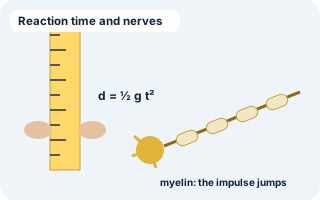
🧪 Try it in the free lab. In the free Nerves lab you catch a virtual ruler, record your own results, plot them, and then compare how fast impulses travel in different neurones.
Open the lab →Why a falling ruler works as a stopwatch
A dropped ruler starts from rest and speeds up at the same rate every time: g = 9.8 m/s², the acceleration due to gravity. So the distance it falls depends only on how long it falls. While you are reacting, the ruler keeps falling. The longer you take, the further it goes.
For an object falling from rest, d = ½ g t². Rearranged for time:
t = √(2d ÷ g)
The method, step by step
- Sit with your forearm on a table and your hand over the edge. Hold your thumb and first finger about 2 cm apart.
- Your partner holds a 30 cm ruler upright, with the 0 cm mark level with the top of your thumb.
- Without warning, your partner lets go. Catch the ruler as fast as you can.
- Read the mark level with the top of your thumb. That is the distance d.
- Repeat 5 times. Leave out any result that is very different from the others, then take the average.
- Change the distance to metres (divide by 100) and use t = √(2d ÷ g).
Keep it a fair test: same hand, same starting gap, same partner, and no counting down before the drop.
Ready-made table: distance to reaction time
| Ruler fell (cm) | Reaction time (s) |
|---|
| 5 | 0.10 |
| 10 | 0.14 |
| 15 | 0.17 |
| 20 | 0.20 |
| 25 | 0.23 |
| 30 | 0.25 |
Most people catch the ruler between 12 cm and 25 cm, which means 0.15 s to 0.23 s. If you miss it completely, write “more than 0.25 s”.
Worked example
Aline’s five catches: 18 cm, 21 cm, 19 cm, 35 cm (she was talking), 20 cm.
- Leave out 35 cm, because it is far from the others.
- Average of the other four: (18 + 21 + 19 + 20) ÷ 4 = 19.5 cm = 0.195 m.
- t = √(2 × 0.195 ÷ 9.8) = √0.0398 = 0.20 s.
What happens inside you during those 0.2 seconds
Catching the ruler is a voluntary response, not a reflex. Light from the moving ruler reaches receptors in your eye. Sensory neurones carry impulses to the brain, which decides to act. Motor neurones then carry impulses to the muscles of your fingers. Every synapse on this path adds a small delay.
A reflex, such as pulling your hand off a hot pan, is faster. It uses a short path through the spinal cord, and the brain is told only afterwards.
Why this matters on the road
On a real road, people take longer to react than in a ruler test, often about 1 second: they are not expecting the danger, and they must first notice it. A moto-taxi travelling at 40 km/h covers 11 metres every second. So the moto travels about 11 m before the rider even starts to brake. Tiredness, alcohol and looking at a phone make reaction time longer, and that distance grows.
You can test this yourself. Measure your reaction time while counting backwards from 100 in threes. Most people catch the ruler much later.
🧪 Nerves lab: reaction time and impulses · free, works on any phone, with graphs, questions and a lab report.
Start the lab →Questions people ask
Is catching a ruler a reflex?
No. It is a voluntary response, because the brain decides to close the fingers. Reflexes use a shorter path through the spinal cord and are faster.
What is a normal reaction time?
In the ruler test most students get between 0.15 s and 0.25 s. With practice the time usually gets a little shorter.
Why do I have to use metres in the formula?
g is 9.8 metres per second squared, so the distance must be in metres too. For example, 20 cm is 0.20 m.
Can I make a reaction-time ruler?
Yes. Use the table to mark the times beside the centimetre marks: 0.10 s at 5 cm, 0.14 s at 10 cm, up to 0.25 s at 30 cm. Then you read the time directly.
Practise this topic
Written by BIZIYAREMYE Donat, Senior Physics and STEM Teacher, Rwanda. Found a mistake? Write on WhatsApp 0788 804 242. More explainers · All Interactive Labs